Friday, 11 November 2011

Photos from a Fungi Foray in Falconwood

While you may have been disappointed to see the weather taking a turn for the wetter over the last few days, thousands of fungi have been lapping up the damp and starting to fruit in the form of mushrooms. On Wednesday John from the Sustainability Team went foraging in Falconwood to see what he could find.

A selection of fungi picked and brought back to the office for closer inspection

Lepista nuda (Wood blewits) they have a distinct perfumed smell and a rich lilac colour

Lycoperdon perlatum (Common puffball) edible when young and quite easy to identify

Agaricus silvicola (Wood mushroom). This mushroom was very damp and fragile and found hiding among the brambles - ouch!  

Lepista nuda (Wood blewit) growing in a small troop among the leaf litter.

Chlorophyllum rhacodes (Shaggy parasol) this one is edible but can be quite easily confused with poisonous varieties

Clitocybe nebularis (Clouded agaric) there are hundreds of these toadstools scattered all across Falconwood
Clitocybe nebularis (Clouded agaric)

Monday, 7 November 2011

Saving Energy in the Halls of Residence

Two University of Greenwich Students have been entered into the national competition for the monthly Student Switch Off photo competition. Ross and Malaika’s photo (see the competition here http://tinyurl.com/co3yn8p) is up against a whole host of pictures of students from other universities showing off their energy saving efforts. The pictures with the most ‘likes’ on Facebook get to pick their prizes from a whole load of Ben and Jerry’s ice cream, Amazon vouchers and THTC t-shirts. 

The competition finishes on Friday, so make sure you get onto the Facebook page and vote for them now! Even if it doesn't win the overall competition Ross and Malaika will no doubt be pleased with the money they saved by wrapping up instead of switching the heating on. They will also be in with a chance at winning the Avery Hill Halls energy saving competition where the flat that uses the least amount of energy wins an massive Ben & Jerry's ice cream party at the end of the year!

If you're looking for some energy saving ideas have a look at our Eco Power Ranger saving energy, time and money in his morning ritual.


If you want some help coercing your housemates into joining you in your energy saving crusade - Katie from People and Planet has written a blog post on exactly that: http://blog.peopleandplanet.org/2011/11/how-to-train-your-housemates-in-energy-saving/

Friday, 4 November 2011

Bigger, Better but with a Smaller Footprint.....

Green Impact II: The Sequel
Tuesday saw the launch of the second year of the University’s Green Impact project and Sustainability Champions Network. The project brings together sustainability champions from nearly every department within the University to complete a workbook-full of tasks set to improve the University’s environmental performance.
John tries to explain how much bigger the new workbook is
There are a lot of new sustainability champions joining the network this year bringing the total number of staff members implementing the Green Impact workbook to over 40. The champions will be trying to earn their department either Bronze, Silver, Gold or Platinum awards before they hand the workbooks in before Easter next year. Joining the various schools and offices in the University taking part in the scheme will also be Hadlow College – one of the University’s partner colleges that is working to reduce their carbon footprint and looking for new initiatives to do this. Sue Brimlow the college’s Sustainability Manager joined us for the event to find out what they could gain from working with Greenwich on implementing Green Impact workbook at Hadlow.

Kat Thorne – Head of Sustainability for the University kicked of proceedings by giving us an overview of sustainability at the University and how the global issues of population growth and increased demand on resources are impacting on the university. This was followed by highlighting some of the key areas of the Sustainability Policy and how the University was implementing them plus emphasising some of the key areas the Sustainability Team will be working on over the next 12 months.

Following Kat was David Young, one of the sustainability champions for IT at the Greenwich campus and self-titled ‘University of Greenwich Quiz Master’ – who’d put together an interactive quiz (Who Wants to be a Millionaire style) just to make sure the sustainability champions were listening to Kat’s speech. Despite a few iffy answers we are pleased to announce that the vast majority got the answers correct. Following the quiz John Bailey the Sustainability Projects Officer for the University went on to explain a few of the ins and outs of how the sustainability champions network works and how the new champions could expect to be communicating the sustainability message across the university.

Charlotte Taylor followed up giving us a national perspective on the NUS Green Impact scheme and showed how it had grown from being a pilot project at Bristol University to being taken up by 48 different universities for this academic year. At the University of Greenwich the sustainability champions completed 561 tasks through the Green Impact scheme and this fantastic number is being repeated all around the country with nearly 4,000 people directly involved and 19,620 tasks completed across the 35 universities that took part last year! That’s a great achievement and just goes to show how we are not alone fighting the sustainability corner but part of a much larger positive movement taking place nationwide!

Neil demonstrates a hire bike Brompton folding away
As well as Neil Garrod giving the champions a sneak preview of the University's proposed Brompton bike hire scheme (complete with a slick demonstration of how to fold a Brompton bike as if trained by Mr. Brompton himself) he talked about how he'd recently gone back to look at the book on 'nudge theory' after recently surfacing on the government's agenda. He mentioned how the nudge theory applied to the work that the champions are doing across the University and would be key to successfully embedding the behaviour change that is needed in order for the University to achieve its sustainability goals.

Neil has been championing sustainability for over 20 years and cited an example about being viewed as a lone nut while working at a previous university where he tried to bring sustainability onto the agenda through the medium of recycled toilet paper. Neil has seen a change in the support from senior management at the University of Greenwich; he used to be the only one championing sustainability with others claiming that sustainability was not a priority. He now finds himself in the opposite situation with those who used to claim that sustainability is not a priority now championing sustainability themselves. The University’s high score in the People and Planet Green League and the potential savings shown in the carbon management plan have swayed the senior managers and explained to the sustainability champions that they need to understand what sustainability means to those they work with and appeal to their colleagues' individual agendas. 

Graeme Collie explains the culinary delights on offer
After the morning’s speeches and presentations we were delighted with a sustainable hospitality menu from the university’s caterers ABM Catering. Graeme Collie from ABM explained how the menu had made best use of local, seasonal, organic and free-range or high welfare ingredients and that they were working towards achieving a Silver Food for Life Award after implementing so many positive changes to the menus.

John Bisbrown explaining the results from the first workshop

Sustainability champions discussing some of the challenges ahead
The afternoon was packed full of workshops focused on challenging areas in the workbook and gave the champions a chance to work together to find a practical and pragmatic way of implementing some of the tasks. There was a strong focus on communication – as ever with sustainability – half the task is in how you communicate to your colleagues and win them over to the new practices and behaviours you are trying to implement. Positivity is a key message and focus for sustainability communications and is often far more effective than pedalling the doom and gloom stories. The Green Impact project and the Sustainability Policy and strategy are starting the move towards creating a more efficient university that creates a net positive impact. We finished the workshops with a great video from TED on how to start a movement in less than three minutes and how ‘a lone nut can become a leader’.

Friday, 28 October 2011

Breaking Ground at our Community Garden and Gearing up for the Orchard Planting

Today the Sustainability Team joined forces with the School of Architecture, James Hallybone and Tom Barnsley from Roundfield and Michael Unsworth from the Grounds team to break ground at the site for our new community garden. We haven’t quite started to dig to plant yet but we have dug one meter below the surface to inspect the soil and get an idea of what the quality is like.

Ducan Goodwin gets into the hole to investigate the soil
So what’s it like then I hear you cry? Well, just below the surface there is a fair bit of rubble – not too much though, then after that there’s some well drained soil a few pebbles and gravel and then the clay. The School of Architecture first year garden design student will returning to the site to do some more robust testing over the coming weeks but certainly the first look is positive. The soil may not be of an award winning standard it is certainly good enough that we can get a bit of compost mixed in and start digging and planting when the time is right.

Looking at the different layers in soil
We are now looking for students, staff members and locals who are interested in getting their hands dirty and getting involved with either the design, building of, maintenance and growing in the garden. If you are interested please email: sustainability@greenwich.ac.uk

Sticking with the theme of growing your own, we are just one month away from our orchard planting at the Avery Hill Campus. On the 1st December this year we will be planting 20 trees including ten varieties of apple, three varieties of pear, two plum trees, two cherry trees, a damson, a medlar and a mulberry tree. The orchard will need staff and students to adopt a tree for watering, pruning and a little bit of care, particularly for the first two years. Not to worry if you don’t have any experience in managing orchards for the London Orchard Project will be offering a training session telling you exactly how to look after a tree through its early years. Once again if you want to be involved in the planting of and adoption of one of our trees please email us at: sustainability@greenwich.ac.uk

Seeing as its Halloween this Monday we have a few little interesting links that we've noticed come up today. Firstly over at Planet Pals they have a nearly endless supply of ideas for a green Halloween: http://planetpals.com/green-halloween and Creations by Kara have come up with a great way of recycling an old book into a pumpkin that you will be ablt to use year after year: http://www.creationsbykara.com/2011/09/book-page-pumpkin-tutorial.html

Creation by Kara: Pumpkin book
P.S. Don't forget to turn the bottles of sloe gin you made last week!

Friday, 21 October 2011

Sloes and Carbon 2.0 Can London Lead the Low carbon Revolution?

This week the Sustainability Team celebrated the arrival of winter and the first frosts in London by using our lunch breaks to harvest hundreds of sloes from the countless bushes spread across Avery Hill Campus. Sloes are the berries found on the Prunus spinosa or blackthorn bush – a common shrub or small tree found in hedgerows all across the United Kingdom and are abundant among the rosehips (Rosaceae), hawthorns (Crataegus) and snowberry (Symphoricarpos albus) hedges at Avery Hill.


Avery Hill Sloes Picked on Monday
With the sloes we have been busy making sloe gin, a liqueur that is made by mixing the berries, sugar and gin. This year Nigel Slater’s recipe is the one being followed:

“Prick your sloes, about 450g, with a needle or freeze them and bash with a heavy weight. Tip them into sterilised bottles, the fruit coming a third of the way up. Divide 350g of caster or granulated sugar among them then top up with gin or vodka. It will take about 750ml. There is little point in using an expensive brand, by the way. Place the sealed bottles somewhere cool and dark. Leave for 8-10 weeks, turning the bottle occasionally, giving it a shake every week.” (taken from: http://www.guardian.co.uk/lifeandstyle/2010/oct/10/nigel-slater-classic-sloe-gin-recipe)

It is best to avoid the recipes that start with, “buy a bottle of gin, drink half....”

As well as picking sloes the Sustainability Team has been gallivanting around central London. On Wednesday evening we headed to London’s City Hall for the event ‘Carbon 2.0: Can London lead the low-carbon revolution?’ The event was put together by Carbon Culture, an organisation that tries to marry up the technical and cultural approaches to embedding sustainability in an organisation. Carbon Culture’s most famous work is the real-time energy monitoring for the Department for Energy and Climate Change that we have mentioned on this blog before: http://greengreenwich.blogspot.com/2011/09/carbon-management-plan-update.html.

View from the top of City Hall: Tower Bridge with Canary Wharf in the background.
The panel was debating the title question and taking questions from the floor that was made up from staff of universities, councils, airports, financial Institutions, construction companies, charities, theatres and a whole host of sustainability minded professionals from the public and private sector. While the overriding feeling at the event was positive and the panel seemed to genuinely believe London (and perhaps more specifically intelligent design) could bring about the low-carbon revolution there were also a lot of quite challenging questions.

- How do you cater for a global middle class that will have 3 billion more people?
- How can you join use technology to influence behaviour?
- What future is there for consumerism?
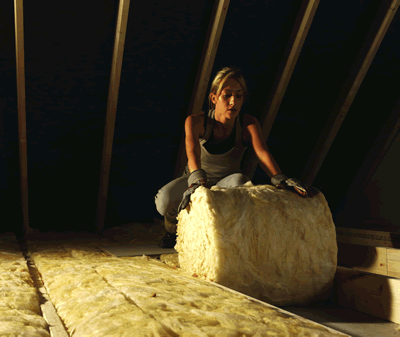
- How do you make loft insulation sexy?

Phwoarr! Check out that loft-insulation!
The questions are intrinsically linked and if you can find an answer you also provide an answer for a lot of other questions regarding the world of sustainability. Luke Nicholson from Carbon Culture was keen to push the idea that you need to make your sustainable solution/product appealing to the end user. If you can give someone what they want, they will use it and it is only once they are already engaged with it that you add the ‘sustainability story’. As long as the popular products and practices of the future are low carbon then you are already on the way towards a sustainable future effectively by ‘tricking’ people into sustainable practices. By answering the last of the four questions you can perhaps see how this might work – instead of selling loft insulation as a great way of saving money and cutting carbon emissions, sell it as a way of making your home warmer, more cosy, a more desirable place to live and for friends to visit and stay. This is a well known method for communicating sustainability and Futerra’s ‘Sell the Sizzle’ is the sustainability communicator’s bible: http://www.futerra.co.uk/downloads/Sellthesizzle.pdf.

As for the future of consumerism, well we have already decided everyone will be buying into great technologies that are not only appealing but also more sustainable - but how do you cater for the extra billions of people projected to be living on the planet over the next decades when you have limited resources to go round? Mat Hunter from the Design Council suggested making London a ‘shareable city’ a place where ‘collaborative consumption’ is the order of the day. Instead of everyone owning a car people will be members of car clubs like StreetCar or ZipCar, instead of owning a bike people will use the ‘Boris Bikes’. Mat Hunter was particularly positive that London could lead in this way because the city is ‘a densely packed vast Petri dish with a concentrated group of highly intelligent people.’ High praise indeed for London.

Friday, 14 October 2011

Education for Sustainable Development

This week has seen the Sustainability Team spread across all three campuses flitting from meeting to meeting and from one sustainability event to another. This week we have had the Sustainable Procurement Exhibition - giving staff members a chance to meet suppliers and quiz them on their sustainability credentials, a meeting with Kent University and Canterbury Christchurch University about combining the three universities' efforts on Green Impact, the monthly meeting of the London Universities Environmental Group and an appearance on the Guardian HE Network website! Phew!

On top of all that yesterday saw the bringing together of teachers, researchers, directors, students and other interested parties for an 'open-space' event to discuss the strategic direction for embedding sustainability across the university's curriculum. The event saw everyone discussing three key topics agreed by the group as key to embedding sustainability across the institution: Staff Training and Communications, Student Engagement and Institutional Approaches. The format of the event saw everyone split into smaller groups and really focus on the key issues at hand and to develop some actions for everyone to vote on.

Voting on the best actions for engaging students with sustainability
 
What actions can you take for communicating sustainability?

What would be the best institutional approaches for embedding sustainability into the curriculum?

Mind map of key issues with communicating sustainability among the staff body
There were some particularly popular actions chosen to steer the University towards embedding sustainability in the curriculum - the most popular choice being that students could take part or are required to take part in a course or unit that includes sustainability outside of their faculty and normal course programme. Another particularly popular choice among the students was using Wednesday afternoons for volunteering or sustainability activities as an alternative to sporting activities. The group has agreed to meet again and keep track on the progress of how the embedding process is going and we will of course be keeping you updated here on the blog.

Friday, 7 October 2011

How can social media help communicate sustainability?

On Wednesday the Guardian Sustainable Business Hub were hosting a seminar on communicating sustainability through the medium of social media. As keen bloggers, tweeters, facebookers, and linkedin-ers of sustainability this seemed right up the street of the Sustainability Team and we sent John Bailey along to investigate....

First up was Caroline Holtum, the Head of Content for the Guardian Sustainable Business Hub who gave us a little background on the hub and how it has fared over the last 12 months. Their first birthday is this coming Tuesday and if you haven’t ventured to the hub make sure you have a look. The hub brings together sustainability research, stories and news from the business world as well as organising events like the one I went to this week. On top of this they have an email newsletter allowing you to keep up to date with the stories of the moment.

Guardian Offices near Kings Cross
Following Caroline’s welcome Matthew Yeomans took up the reins to explain ‘why storytelling is key to social media communications'. Matthew’s first major foray into social media research was while writing a Sunday feature for a major US newspaper that was eventually dropped at the last minute – dismayed that the last two months of research and writing may not ever see the light of day he wrote about his findings and how he got there on a blog. This blog kick started his career in social media and now a few years later Matthew is working as a social media consultant, the founder of Custom Communication and Social Media Influence and has a captive audience of sustainability and communications professionals keen to hear his thoughts.

Matthew took us through the world of major social media screw ups, highlighting a few of the big corporations that have suffered at the hands of the world of social media campaigns. It turns out a lot of them were about sustainability related issues and a large number of the campaigns were run by Greenpeace. One example is Greenpeace’s recent social media campaign targeted at Mattel for using packaging that used pulp made from unusustainable wood sources. Greenpeace used twitter and youtube to create a fun campaign involving Ken breaking up with Barbie, and 'Chainsaw Barbies' being hidden around the UK to draw attention to the issues. As a result of the campaign Mattel have now agreed to use paper that is 70% recycled or sustainable material by the end of 2011. You can see Matthew’s social media screw ups summary on slideshare: http://www.slideshare.net/socialmediainfluence/social-media-screw-ups

The aptly named 'company screw up chart' shown by Matthew Yeomans
Matthew was insistent that the keys to using social media are to be honest, respect your audience and to be useful – social media grew as a response to PR spin, giving people the chance to rant and complain but also to share. Companies and organisations using social media have to move beyond slick marketing campaigns, know their audience and be where there audience is – this can be everywhere!

James Farrar, Vice President of Sustainability for SAP (software company developing business management software) was next up to explain how IT can be a catalyst to sustainability. He demonstrated how SAP had made their sustainability report available to be manipulated and shared by users using social media. The report can be seen here http://www.sapsustainabilityreport.com/operations-impact. It contains a breakdown of the key environmental, social and economic impacts including energy consumption, women in top management, revenue and customer satisfaction. The interactivity of the report reminded me of the energy use displays we saw in Hadlow College’s Rural Regeneration Centre and the work that Carbon Culture have done for the Department of Energy and Climate Change.

Screenshot of SAP Carbon Footprint
SAP allows users' tweets to appear on the website meaning that they end up with real time, honest feedback from their customers. While this does carry a risk if your customers are not happy with your service, making sure that you are honest, transparent, providing a decent service and responding to your customers complaints and queries. This is a good way of ensuring that you don’t end up enduring the wrath of angry customers. The worst thing you can do is block someone’s tweets from appearing on your site – this will only encourage them to round-up their followers and re-tweet the offending message!

My top James Farrar quotes and tips from the presentation are:

- Treat online engagement as seriously as you would a journalist from a national newspaper
- Tell a story that works with social media (interactive, interesting, useful)
- One dimensional sustainability reporting is like a lighthouse in a bog
- You don’t need a sustainability strategy, you need a strategy that is sustainable
- Never let your CEO have a blog! (Correction: this point was Matthew Yeomans' advice)

(Interesting last point as he said this on a day that we found out our new Vice Chancellor David Maguire is going to be writing a blog - http://blogs.gre.ac.uk/vc/ - however as an experienced blogger of ‘GIS Matters’ and arguably one of the most technically savvy Vice Chancellors around I think we can breathe easy, particularly if his first full post is anything to go by! And to be fair, James Farrar pointed out some good examples of CEO blogs.)

David Maguire the New VC at Greenwich's blog
After a coffee and a biscuit it was the turn of Jo Confino, an executive editor at the Guardian to wrap things up before we took on a role-play exercise. Jo’s words of wisdom included one bit of advice for anyone wanting to become a social media leader in their field – make sure your stories / blogs / posts / tweets are sector-wide rather than just limiting them to your own organisation. As we turned to the role play it gave us the perfect opportunity to chat with other attendees at the seminar and of course social media was the hot topic.

Harriet Waters from the Sustainability Team at Oxford Brookes told me that she’d been comparing our social media ‘Klout’ – an online programme that works out how influential you are on the main social media sites. Currently the Sustainability Team’s score is 34 – not bad but plenty of room for improvement. The group also discussed using TweetDeck and HootSuite two programmes for keeping track of multiple social media channels – especially useful if you have a presence on more than one social media network. Another little piece of online software that we will be using at the first given opportunity is software that works with your PowerPoint presentation to bring together all the latest comments people have made about a particular topic. You can download it for free from here: http://www.sapweb20.com/blog/powerpoint-twitter-tools/

If you want to follow the Sustainability Team through the various social media channels we appear on click the links below:

Twitter: twitter.com/Sust_Greenwich

Facebook: http://www.facebook.com/pages/Sustainability-University-of-Greenwich/246156035408445#!/pages/Sustainability-University-of-Greenwich/246156035408445