Thursday, 1 December 2011

New Orchard at Avery Hill

Today staff, students, local residents, graduates, friends, family, children and a member of parliament came together to plant a community orchard at the University of Greenwich. At Avery Hill Campus a huge group of volunteers (and a couple of experts from the London orchard Project) took a break from their regular working day to get their hands dirty and plant one of 20 fruit trees in the new community orchard.


The orchard will be supplying staff, students and local residents with a tasty array of fruit (apples, pears, medlar, plums, cherries, damsons, mulberries) for coming decades! It has come as a result of a partnership between the University and the London Orchard Project, who are creating new community orchards in London’s unused spaces to promote community production and ownership of fruit. Plus of course helping us rediscover the pleasures of eating fruit grown close to home (or work). These community orchards are contributing towards the ‘greening’ of the urban environment and are creating new and enhanced habitats for wildlife – especially true at Avery Hill where the orchard will be surrounded by long grass and wildflowers which will be great for encouraging bees, insects and the predators of pests such as aphids and codling moths.
A dozen spades prepare for the digging

The orchard planting is part of a wider University push to improve and enhance the biodiversity on campus and promote local food. The majority of trees have been chosen to fruit during University term time and after three years some of the apple trees will be producing about 300 apples per crop. Students at Avery Hill will never need to buy an apple again!

Russell from the London Orchard Project teaching the volunteers how to plant a fruit tree

Claire Evenden, who came with her colleagues from the Student Records, planted an apple tree called a ‘Fiesta’, said she was looking forward to watching the tree grow from her window in the Bronte building.

Paulina Bush from the University of Greenwich nursery came along with a dozen children who planted two of the apple trees (Discovery and Pinova) with the spades they normally use for maintaining their forest garden. Paulina said that the children would be coming back to the orchard regularly to water the trees and of course help harvest the fruit as well!

The volunteers digging away and planting the trees
 The plan is not to stop at just an orchard either. Close to the orchard we have a space on the Southwood Site where work is about to commence on a community allotment and forest garden, with plans for a nut orchard (or is that a nuttery?), a vineyard and hops also being considered for future food growing projects. Of course if you would like to find out more about any of the food growing projects or indeed get involved with the allotment and forest garden please email us at: sustainability@greenwich.ac.uk

Here is a complete list of the 20 fruit trees planted on campus today:
 
Apples:
1. Egremont Russet. Late Victorian English variety, most important commercial Russet, a hardy variety with a nutty, sweet flavour ripe in late September. Originated in Sussex in the early 1800s.
2. Falstaff. Very good disease and frost resistance, crisp and juicy red desert apple, ripe late September
3. Tydeman's Late Orange. Variety raised in 1930s in Kent, rich aromatic flavour, firm and sweet, orange to red in colour, picking time mid October. A cross between a Laxton Superb and a Cox Orange Pippin, but a lot easier to grow than a Cox Orange Pippin. Picking time mid-October
4. Tentation. New variety, yellow to golden fruit, picking time late September and stores until March
5. Greensleaves. Green to yellow mid-season apple, tasting a bit like a Golden Delicious, picking time mid-September. We think this apple is essential due to the Henry VIII theme it shares with the campus buildings. Fruits mid-September.
6. Fiesta. Another Cox-like apple but hardier. Heavy cropping with brightly coloured, aromatic fruits, picking time early October.
7. Pinova. A hardy tree with Cox and Golden Delicious as parents. The fruit hangs late on the tree and stores well. Harvesting time late September.
8. Discovery. Bright red, crisp, juicy with a sharp fresh flavour. This is an early apple (early August) so will provide fruit for staff/ any students on campus over the summer.
9. Bramley's seedling. The classic British cooker, grown from seed in a garden in Nottingham, the original tree is 200 years old and still going strong. Creamy white flesh, full of flabour – though there are alternative cookers if you want something more unusual. Also makes lovely sharp juice.
10. Howgate Wonder. A cooker that can also be eaten/ juiced when fully ripe. Pale green with brown-red flush, fruits early October.
Pears:
11. Doyenne du Comice. French pear grown from seed, first fruiting in 1849. Reached England in 1858 and soon became very popular for its delicious flavour and jucy texture. Picking mid-October.
12. Williams Bon Chretien. Pears known to the Romans, considered by the best pear in the 16th century. Raised by a schoolmaster in Aldermarston near Reading in 1770. Needs to be eaten off the tree in September as does not store.
13. Concorde. A reliable, heavy cropper with melting, juicy flesh. Picking time late October.
Plums and other stone fruit:
14. Marjorie’s Seedling. Excellent late plum (picking time late September). Oval-shaped purple fruit with yellow flesh.
15. Victoria. A classic plum, discovered in a garden in Sussex and named after Queen Victoria. Picking time is August so another fruit for staff and summer-students to enjoy.
16. Shropshire Damson. A hardy damson with some plum-like characteristics. Best used for cooking and has a rich flavour but can also be eaten from the tree if left to ripen. Picking time late August / early September.
17. Cherry Early Rivers. One of the earliest cherries, with very dark skin and flesh, and excellent flavour. Produces a heavy crop, ready for picking in mid-June.
18. Cherry Stella. Juicy dark-red cherries, ready for picking in late July. Fruiting time isn’t ideal for students but it does make a good pollinator for other cherries.
Other fruit:
19. Medlar. A beautiful, squat and spreading tree with attractive blossom. It is also interesting from heritage perspective, being popular in the middle ages and mentioned by Chaucer as being “ripe when rotten”. Picking time is November and the fruits should then be left to decay (blet) before turning soft and sweet.
20. Black Mulberry. A large stately tree that will grow to form gnarled branches and a distinctive form. The fruit is delicious and almost never commercially available. Said to have been introduced in the 16th Century in the mistaken belief that black mulberries harbour silk worms. (In fact silk worms live on white mulberry trees.)


Monday, 21 November 2011

Medway Campus Green Impact Collaboration

On Thursday the University of Greenwich teamed up with the University of Kent and Canterbury Christ Church University to bring the efforts of the three universities together in implementing the Green Impact workbook at the Medway Campus. All three universities are taking part in the NUS Green Impact project and are working on three variations of the Green Impact workbook, which sets out tasks for improving the office or department you are working in. The project includes regular workshops which are run at each campus but rather than three different people running three different workshops for three different sets of sustainability champions we decided to bring the whole lot together in one big Medway Green Impact workshop.


Emily Crockford from Kent and Lucy Brown from Canterbury Christ Church lead a group task in the workshop.
 The workshop was focussed around introducing the concept of the Green Impact workbook to those that were new to the project and demonstrating what will be expected of the champions when they come to present their evidence during the auditing process. On top of the more regular parts of the workshop we had an exciting opportunity to demonstrate the crossover work, collective targets and opportunity for collaboration between the three universities.


Sustainability Champions from Greenwich, Kent and Canterbury Universities working together at Medway

The Medway collaboration will give sustainability champions a chance to share their work and ideas between all three universities and give everyone a chance to benefit from examples of best practice and the experiences of a wider pool of sustainability champions. At the same time the three respective sustainability teams implementing the Green Impact project at their campuses are benefiting from sharing ideas and resources for putting together the workshops and activities for Green Impact but are also able to discuss implementing sustainability on a wider reaching level across the three different universities. We are expecting this to be the start of a long and happy partnership between the three universities and a great opportunity for all involved to share the workload and push forward in implementing the Green Impact project.

Either side of the Green Impact workshop at the Medway Campus John Bailey was moonlighting as a guest lecturer for the civil engineers. After attending the ‘Sustainability Induction’ staff development workshop Deborah Sims, a senior lecturer in Civil Engineering decided that her students would benefit from seeing how the university is implementing sustainability on a practical level to go hand in hand with the theory the engineers are already learning. Thus she invited John to come to Medway and talk to two sets of engineering students that she teaches. The lectures gave the students an overview of some of the global challenges around population growth and resource use followed by a focussed insight on what these challenges mean to the university, how the university is responding to these challenges and what we can all do on a personal level.


Friday, 11 November 2011

Photos from a Fungi Foray in Falconwood

While you may have been disappointed to see the weather taking a turn for the wetter over the last few days, thousands of fungi have been lapping up the damp and starting to fruit in the form of mushrooms. On Wednesday John from the Sustainability Team went foraging in Falconwood to see what he could find.

A selection of fungi picked and brought back to the office for closer inspection

Lepista nuda (Wood blewits) they have a distinct perfumed smell and a rich lilac colour

Lycoperdon perlatum (Common puffball) edible when young and quite easy to identify

Agaricus silvicola (Wood mushroom). This mushroom was very damp and fragile and found hiding among the brambles - ouch!  

Lepista nuda (Wood blewit) growing in a small troop among the leaf litter.

Chlorophyllum rhacodes (Shaggy parasol) this one is edible but can be quite easily confused with poisonous varieties

Clitocybe nebularis (Clouded agaric) there are hundreds of these toadstools scattered all across Falconwood
Clitocybe nebularis (Clouded agaric)

Monday, 7 November 2011

Saving Energy in the Halls of Residence

Two University of Greenwich Students have been entered into the national competition for the monthly Student Switch Off photo competition. Ross and Malaika’s photo (see the competition here http://tinyurl.com/co3yn8p) is up against a whole host of pictures of students from other universities showing off their energy saving efforts. The pictures with the most ‘likes’ on Facebook get to pick their prizes from a whole load of Ben and Jerry’s ice cream, Amazon vouchers and THTC t-shirts. 

The competition finishes on Friday, so make sure you get onto the Facebook page and vote for them now! Even if it doesn't win the overall competition Ross and Malaika will no doubt be pleased with the money they saved by wrapping up instead of switching the heating on. They will also be in with a chance at winning the Avery Hill Halls energy saving competition where the flat that uses the least amount of energy wins an massive Ben & Jerry's ice cream party at the end of the year!

If you're looking for some energy saving ideas have a look at our Eco Power Ranger saving energy, time and money in his morning ritual.


If you want some help coercing your housemates into joining you in your energy saving crusade - Katie from People and Planet has written a blog post on exactly that: http://blog.peopleandplanet.org/2011/11/how-to-train-your-housemates-in-energy-saving/

Friday, 4 November 2011

Bigger, Better but with a Smaller Footprint.....

Green Impact II: The Sequel
Tuesday saw the launch of the second year of the University’s Green Impact project and Sustainability Champions Network. The project brings together sustainability champions from nearly every department within the University to complete a workbook-full of tasks set to improve the University’s environmental performance.
John tries to explain how much bigger the new workbook is
There are a lot of new sustainability champions joining the network this year bringing the total number of staff members implementing the Green Impact workbook to over 40. The champions will be trying to earn their department either Bronze, Silver, Gold or Platinum awards before they hand the workbooks in before Easter next year. Joining the various schools and offices in the University taking part in the scheme will also be Hadlow College – one of the University’s partner colleges that is working to reduce their carbon footprint and looking for new initiatives to do this. Sue Brimlow the college’s Sustainability Manager joined us for the event to find out what they could gain from working with Greenwich on implementing Green Impact workbook at Hadlow.

Kat Thorne – Head of Sustainability for the University kicked of proceedings by giving us an overview of sustainability at the University and how the global issues of population growth and increased demand on resources are impacting on the university. This was followed by highlighting some of the key areas of the Sustainability Policy and how the University was implementing them plus emphasising some of the key areas the Sustainability Team will be working on over the next 12 months.

Following Kat was David Young, one of the sustainability champions for IT at the Greenwich campus and self-titled ‘University of Greenwich Quiz Master’ – who’d put together an interactive quiz (Who Wants to be a Millionaire style) just to make sure the sustainability champions were listening to Kat’s speech. Despite a few iffy answers we are pleased to announce that the vast majority got the answers correct. Following the quiz John Bailey the Sustainability Projects Officer for the University went on to explain a few of the ins and outs of how the sustainability champions network works and how the new champions could expect to be communicating the sustainability message across the university.

Charlotte Taylor followed up giving us a national perspective on the NUS Green Impact scheme and showed how it had grown from being a pilot project at Bristol University to being taken up by 48 different universities for this academic year. At the University of Greenwich the sustainability champions completed 561 tasks through the Green Impact scheme and this fantastic number is being repeated all around the country with nearly 4,000 people directly involved and 19,620 tasks completed across the 35 universities that took part last year! That’s a great achievement and just goes to show how we are not alone fighting the sustainability corner but part of a much larger positive movement taking place nationwide!

Neil demonstrates a hire bike Brompton folding away
As well as Neil Garrod giving the champions a sneak preview of the University's proposed Brompton bike hire scheme (complete with a slick demonstration of how to fold a Brompton bike as if trained by Mr. Brompton himself) he talked about how he'd recently gone back to look at the book on 'nudge theory' after recently surfacing on the government's agenda. He mentioned how the nudge theory applied to the work that the champions are doing across the University and would be key to successfully embedding the behaviour change that is needed in order for the University to achieve its sustainability goals.

Neil has been championing sustainability for over 20 years and cited an example about being viewed as a lone nut while working at a previous university where he tried to bring sustainability onto the agenda through the medium of recycled toilet paper. Neil has seen a change in the support from senior management at the University of Greenwich; he used to be the only one championing sustainability with others claiming that sustainability was not a priority. He now finds himself in the opposite situation with those who used to claim that sustainability is not a priority now championing sustainability themselves. The University’s high score in the People and Planet Green League and the potential savings shown in the carbon management plan have swayed the senior managers and explained to the sustainability champions that they need to understand what sustainability means to those they work with and appeal to their colleagues' individual agendas. 

Graeme Collie explains the culinary delights on offer
After the morning’s speeches and presentations we were delighted with a sustainable hospitality menu from the university’s caterers ABM Catering. Graeme Collie from ABM explained how the menu had made best use of local, seasonal, organic and free-range or high welfare ingredients and that they were working towards achieving a Silver Food for Life Award after implementing so many positive changes to the menus.

John Bisbrown explaining the results from the first workshop

Sustainability champions discussing some of the challenges ahead
The afternoon was packed full of workshops focused on challenging areas in the workbook and gave the champions a chance to work together to find a practical and pragmatic way of implementing some of the tasks. There was a strong focus on communication – as ever with sustainability – half the task is in how you communicate to your colleagues and win them over to the new practices and behaviours you are trying to implement. Positivity is a key message and focus for sustainability communications and is often far more effective than pedalling the doom and gloom stories. The Green Impact project and the Sustainability Policy and strategy are starting the move towards creating a more efficient university that creates a net positive impact. We finished the workshops with a great video from TED on how to start a movement in less than three minutes and how ‘a lone nut can become a leader’.

Friday, 28 October 2011

Breaking Ground at our Community Garden and Gearing up for the Orchard Planting

Today the Sustainability Team joined forces with the School of Architecture, James Hallybone and Tom Barnsley from Roundfield and Michael Unsworth from the Grounds team to break ground at the site for our new community garden. We haven’t quite started to dig to plant yet but we have dug one meter below the surface to inspect the soil and get an idea of what the quality is like.

Ducan Goodwin gets into the hole to investigate the soil
So what’s it like then I hear you cry? Well, just below the surface there is a fair bit of rubble – not too much though, then after that there’s some well drained soil a few pebbles and gravel and then the clay. The School of Architecture first year garden design student will returning to the site to do some more robust testing over the coming weeks but certainly the first look is positive. The soil may not be of an award winning standard it is certainly good enough that we can get a bit of compost mixed in and start digging and planting when the time is right.

Looking at the different layers in soil
We are now looking for students, staff members and locals who are interested in getting their hands dirty and getting involved with either the design, building of, maintenance and growing in the garden. If you are interested please email: sustainability@greenwich.ac.uk

Sticking with the theme of growing your own, we are just one month away from our orchard planting at the Avery Hill Campus. On the 1st December this year we will be planting 20 trees including ten varieties of apple, three varieties of pear, two plum trees, two cherry trees, a damson, a medlar and a mulberry tree. The orchard will need staff and students to adopt a tree for watering, pruning and a little bit of care, particularly for the first two years. Not to worry if you don’t have any experience in managing orchards for the London Orchard Project will be offering a training session telling you exactly how to look after a tree through its early years. Once again if you want to be involved in the planting of and adoption of one of our trees please email us at: sustainability@greenwich.ac.uk

Seeing as its Halloween this Monday we have a few little interesting links that we've noticed come up today. Firstly over at Planet Pals they have a nearly endless supply of ideas for a green Halloween: http://planetpals.com/green-halloween and Creations by Kara have come up with a great way of recycling an old book into a pumpkin that you will be ablt to use year after year: http://www.creationsbykara.com/2011/09/book-page-pumpkin-tutorial.html

Creation by Kara: Pumpkin book
P.S. Don't forget to turn the bottles of sloe gin you made last week!

Friday, 21 October 2011

Sloes and Carbon 2.0 Can London Lead the Low carbon Revolution?

This week the Sustainability Team celebrated the arrival of winter and the first frosts in London by using our lunch breaks to harvest hundreds of sloes from the countless bushes spread across Avery Hill Campus. Sloes are the berries found on the Prunus spinosa or blackthorn bush – a common shrub or small tree found in hedgerows all across the United Kingdom and are abundant among the rosehips (Rosaceae), hawthorns (Crataegus) and snowberry (Symphoricarpos albus) hedges at Avery Hill.


Avery Hill Sloes Picked on Monday
With the sloes we have been busy making sloe gin, a liqueur that is made by mixing the berries, sugar and gin. This year Nigel Slater’s recipe is the one being followed:

“Prick your sloes, about 450g, with a needle or freeze them and bash with a heavy weight. Tip them into sterilised bottles, the fruit coming a third of the way up. Divide 350g of caster or granulated sugar among them then top up with gin or vodka. It will take about 750ml. There is little point in using an expensive brand, by the way. Place the sealed bottles somewhere cool and dark. Leave for 8-10 weeks, turning the bottle occasionally, giving it a shake every week.” (taken from: http://www.guardian.co.uk/lifeandstyle/2010/oct/10/nigel-slater-classic-sloe-gin-recipe)

It is best to avoid the recipes that start with, “buy a bottle of gin, drink half....”

As well as picking sloes the Sustainability Team has been gallivanting around central London. On Wednesday evening we headed to London’s City Hall for the event ‘Carbon 2.0: Can London lead the low-carbon revolution?’ The event was put together by Carbon Culture, an organisation that tries to marry up the technical and cultural approaches to embedding sustainability in an organisation. Carbon Culture’s most famous work is the real-time energy monitoring for the Department for Energy and Climate Change that we have mentioned on this blog before: http://greengreenwich.blogspot.com/2011/09/carbon-management-plan-update.html.

View from the top of City Hall: Tower Bridge with Canary Wharf in the background.
The panel was debating the title question and taking questions from the floor that was made up from staff of universities, councils, airports, financial Institutions, construction companies, charities, theatres and a whole host of sustainability minded professionals from the public and private sector. While the overriding feeling at the event was positive and the panel seemed to genuinely believe London (and perhaps more specifically intelligent design) could bring about the low-carbon revolution there were also a lot of quite challenging questions.

- How do you cater for a global middle class that will have 3 billion more people?
- How can you join use technology to influence behaviour?
- What future is there for consumerism?
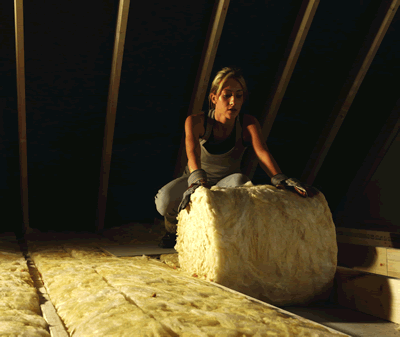
- How do you make loft insulation sexy?

Phwoarr! Check out that loft-insulation!
The questions are intrinsically linked and if you can find an answer you also provide an answer for a lot of other questions regarding the world of sustainability. Luke Nicholson from Carbon Culture was keen to push the idea that you need to make your sustainable solution/product appealing to the end user. If you can give someone what they want, they will use it and it is only once they are already engaged with it that you add the ‘sustainability story’. As long as the popular products and practices of the future are low carbon then you are already on the way towards a sustainable future effectively by ‘tricking’ people into sustainable practices. By answering the last of the four questions you can perhaps see how this might work – instead of selling loft insulation as a great way of saving money and cutting carbon emissions, sell it as a way of making your home warmer, more cosy, a more desirable place to live and for friends to visit and stay. This is a well known method for communicating sustainability and Futerra’s ‘Sell the Sizzle’ is the sustainability communicator’s bible: http://www.futerra.co.uk/downloads/Sellthesizzle.pdf.

As for the future of consumerism, well we have already decided everyone will be buying into great technologies that are not only appealing but also more sustainable - but how do you cater for the extra billions of people projected to be living on the planet over the next decades when you have limited resources to go round? Mat Hunter from the Design Council suggested making London a ‘shareable city’ a place where ‘collaborative consumption’ is the order of the day. Instead of everyone owning a car people will be members of car clubs like StreetCar or ZipCar, instead of owning a bike people will use the ‘Boris Bikes’. Mat Hunter was particularly positive that London could lead in this way because the city is ‘a densely packed vast Petri dish with a concentrated group of highly intelligent people.’ High praise indeed for London.